News Story
SafeLiCell Takes 2nd at Green Business Plan Competition
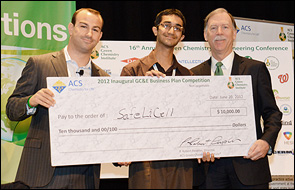
BioE rising junior Mian Khalid (center) at the Green Chemistry Institute Business Plan Competition's awards ceremony.
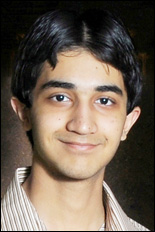
Fischell Department of Bioengineering (BioE) rising junior Mian Khalid represented SafeLiCell, the startup company he co-founded with his advisor, BioE professor Peter Kofinas, and fellow Kofinas Group member, Department of Chemical and Biomolecular Engineering graduate student Aaron Fisher.
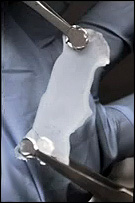
SafeLiCell's product, Lithium Flex, is a light, strong film that can be wrapped or bent into different shapes without breaking, and, unlike current lithium-ion battery electrolytes, contains no combustible or corrosive materials.
By the time the team received their invitations to the ACS's Green Chemistry & Engineering Conference, where the final round of the competition took place, Kofinas and Fisher were scheduled to attend conferences in Korea. They encouraged Khalid to take reins.
"I was very excited to have an opportunity to present SafeLiCell's business plan on my own," says Khalid, "[but] it was definitely a bit unnerving to compete with full-time professionals in the field." Although he felt confident he had delivered a solid presentation and successfully fielded questions from the judges, he admits he was "stunned" to learn he'd earned the $10,00 second prize.
"I am very grateful to have had a chance to present at the conference and to have won the confidence of the judges and the audience," he says, adding that his participation in the competition was an "invaluable experience."
Khalid and the other finalists discuss their work and answer questions from the media. Khalid describes LithiumFlex starting at approximately 6:35.
Video courtesy of the ACS. Streaming by Ustream.
"Mian was the youngest person in the competition by far," says Kofinas. "He's a great example of the caliber of our undergraduates, who have demonstrated they can compete and win in events held at professional and national levels. I am very proud of him."
The Green Chemistry Institute award is SafeLiCell's second significant win. In April 2012, the company took second place in and received a $15,000 prize at the inaugural $100K ACC Clean Energy Challenge business plan competition.
Khalid's work in Kofinas's Functional Macromolecular Laboratory is funded by an Undergraduate Research Fellowship from Howard Hughes Medical Institute. He also majors in English and is a member of the Clark School's Engineering Honors Program and the College Park Scholars' Global Public Health program.
Published June 29, 2012
Related Stories
Stories / November 2, 2012
Khalid Wins College Park Scholars Tri-Star Award
Stories / May 22, 2012
Kofinas Featured on Bloomberg's "Planet Forward" TV Show
Stories / April 27, 2012
SafeLiCell Takes 2nd in $100K ACC Clean Energy Challenge
Stories / April 27, 2012
Award Supports Development of Safer Batteries for Biomedical...
Stories / April 20, 2012
Battery Team Heading for $100K ACC Clean Energy Challenge Finals
Stories / Sep 3, 2026
UMD Convocation will honor five from the Clark School

Stories / Aug 27, 2026
Maryland Engineering Student Organizations (MESO):...

Stories / Aug 24, 2026
UMD Hosts Teachers for a Summer of Sustainable Cooling Research

Stories / Aug 18, 2026
New Faculty Spotlight: Yu Gan

Stories / Aug 4, 2026
Kuo Lab Hosts Future Bioengineers

Stories / Jul 29, 2026
UMD Selected for $17.3M NSF Award to Establish Autonomous...

Stories / Jul 13, 2026
Meet the Newest Cohort of the MARC Program

Stories / Jun 25, 2026
Grand Challenges 2.0: Engineers Partner to Unlock Solutions

Stories / Jun 15, 2026
Alisa Morss Clyne Named Interim Chair of UMD Bioengineering
Stories / Jun 5, 2026
UMD Senior Joshua Mathew Wins 2026 Astronaut Scholarship
